The Missing Link: How the Model Context Protocol (MCP) Safely Bridges LLMs and Enterprise Data
The "Isolated Genius" Problem
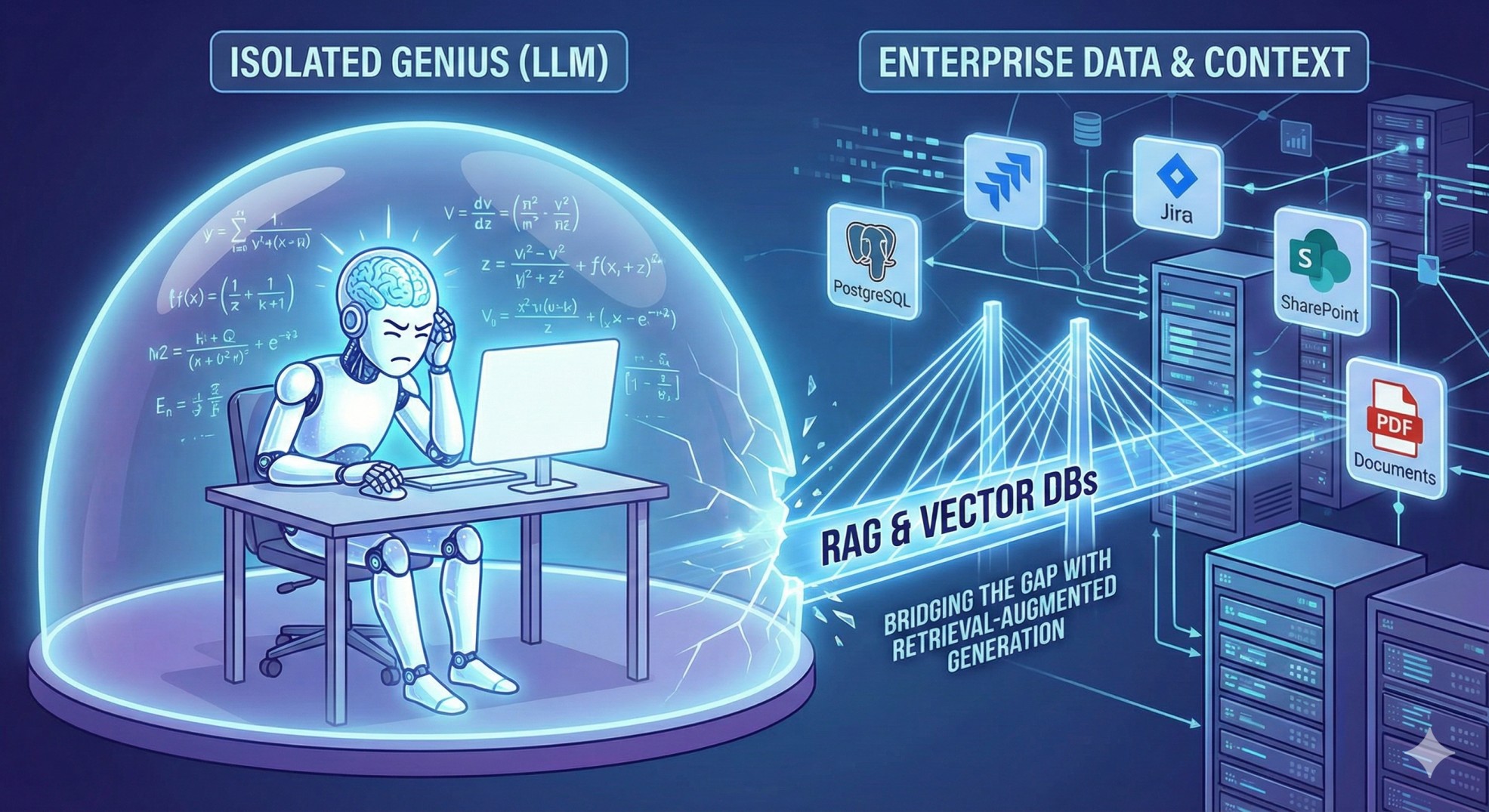
We are past the peak hype cycle of Generative AI. Enterprises know that Large Language Models (LLMs) like Claude, GPT-4, and Llama 3 are incredibly capable reasoners. They can summarize, code, and strategize with brilliance.
But in an enterprise context, an LLM without access to internal data is like a brilliant consultant locked in an empty room. They know the theory, but they don't know your business. They don't know your customer's order history in PostgreSQL, the status of the Jira ticket, or the content of that critical PDF on SharePoint.
To solve this, we build bridges. We use Retrieval-Augmented Generation (RAG) vector databases, and custom function-calling setups.
The problem is that building these bridges is messy, risky, and unscalable.
Every integration requires custom glue code. Connecting Claude to Salesforce requires different code than connecting GPT-4 to Snowflake. More importantly, handing an LLM direct API keys to your backend systems is a security nightmare. How do you ensure the AI only reads what it’s supposed to and doesn't hallucinate a DELETE TABLE command?
Enter the Model Context Protocol (MCP).
What is MCP? (The "USB for AI" Analogy)
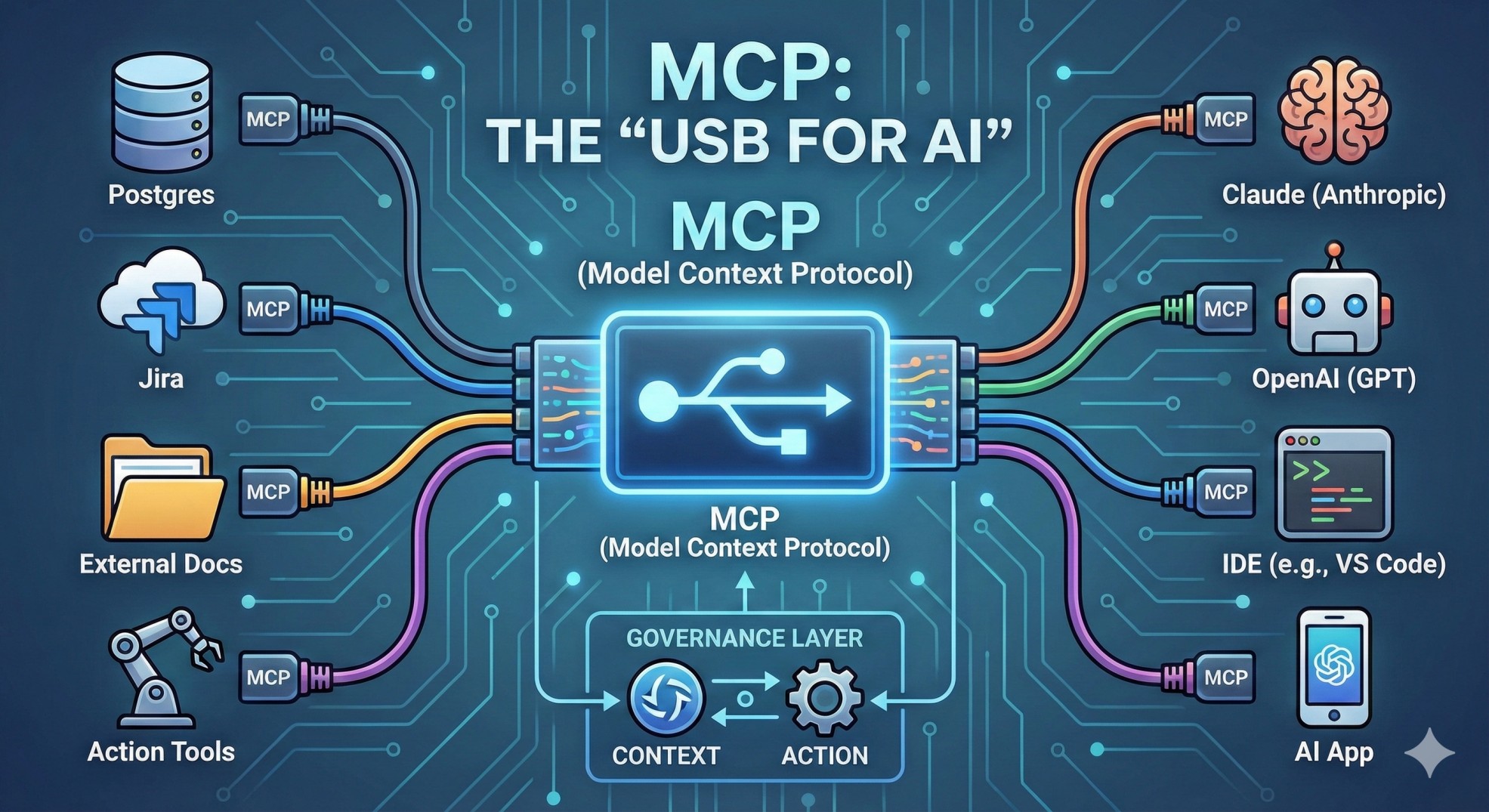
The Model Context Protocol (open-sourced by Anthropic but designed as an open standard) is a universal protocol that standardizes how hosts (like AI applications or IDEs) connect LLMs to external data sources and tools.
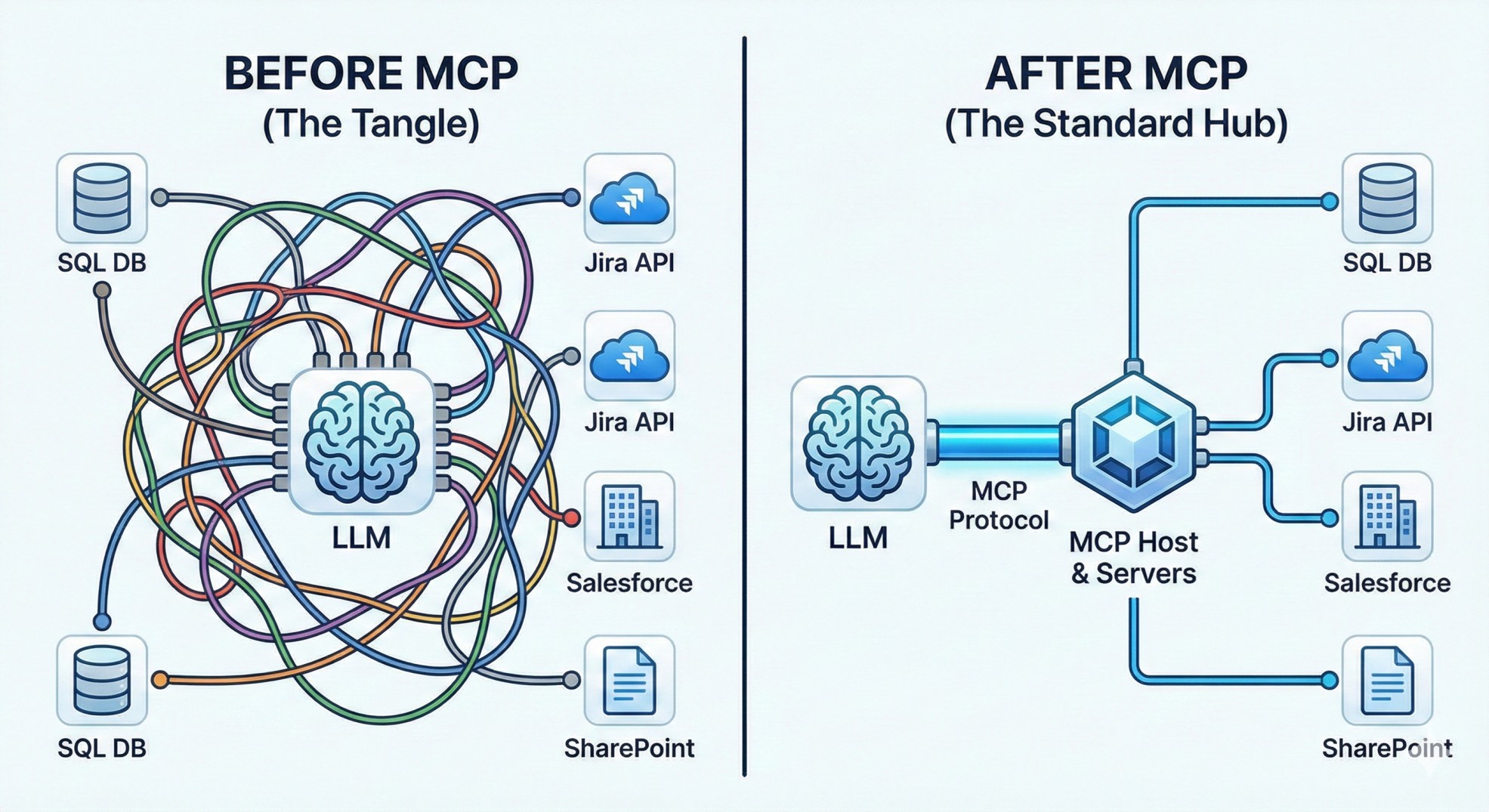
Think of it like USB. Before USB, if you wanted to connect a mouse, a printer, and a hard drive to your computer, you needed three different types of ports and three custom drivers. USB standardized the connection.
MCP does the same for AI:
Before MCP: You write custom Python glue code to connect OpenAI to Postgres, then different code to connect Claude to Jira.
With MCP: You build a standardized "MCP Server" for Postgres once. Now, Claude, OpenAI, or any MCP-compliant host can talk to it using a standard language.
Crucially, MCP isn't just a pipe for data; it’s a governance layer for context and action.
The Architecture: How MCP Works Under the Hood
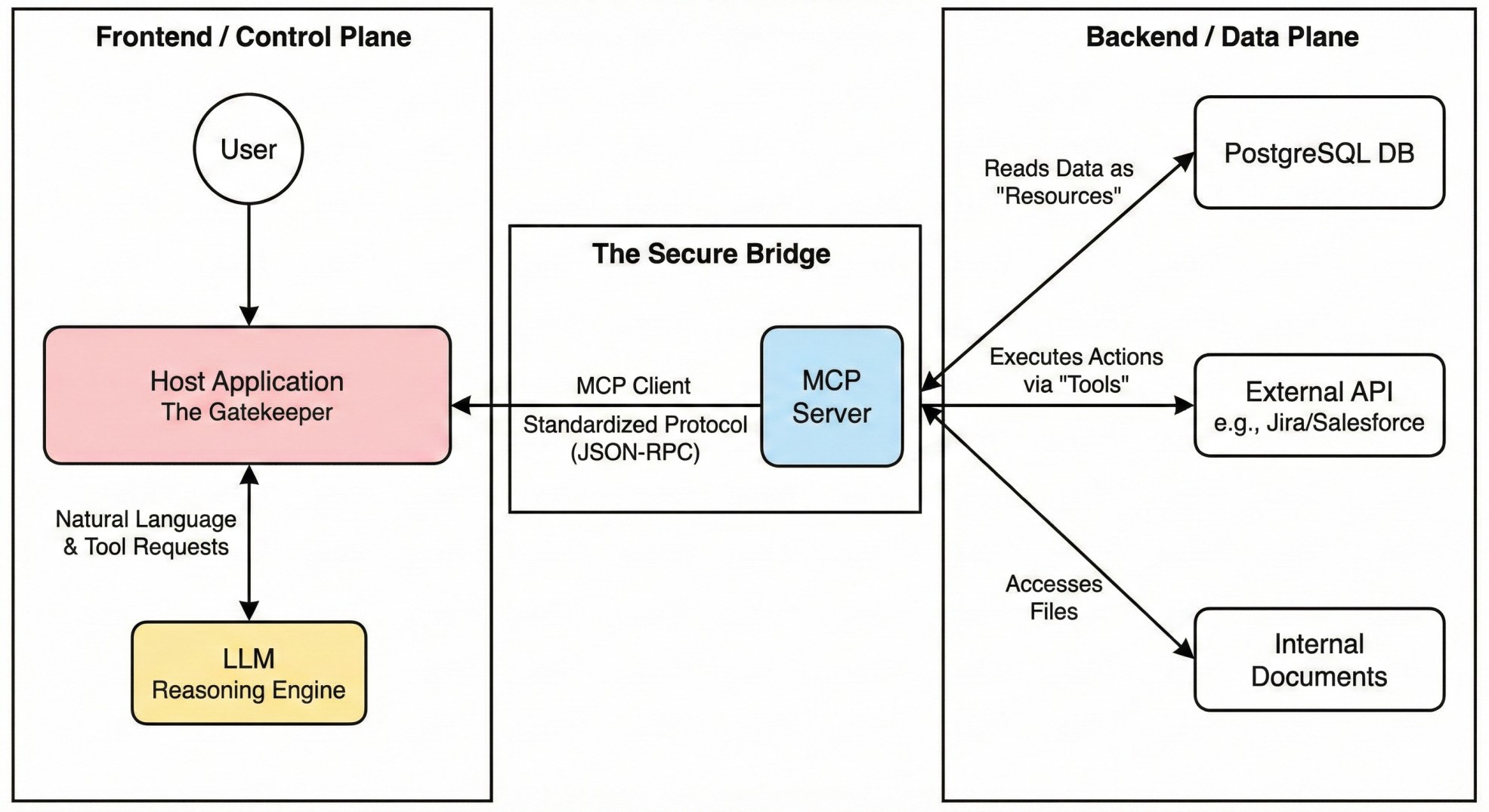
To understand how MCP secures enterprise connections, we need to look at its architecture. It is a client-server model designed to keep the LLM at arm's length from your actual infrastructure.
The Components
The Host (The Client): This is the application the user interacts with (e.g., Claude Desktop, a custom internal web app, Zed IDE). The Host controls the LLM's API key and is the ultimate gatekeeper.
The MCP Server: This is a lightweight application that sits next to your data source. It knows how to talk to your database, API, or file system. It exposes capabilities to the Host.
The LLM: The reasoning engine. It never talks directly to the MCP Server or the data source. It only talks to the Host.
The Primitives (What they exchange)
MCP Servers expose three main things to Hosts:
Resources: Read-only data. Think of these as files or documents that provide context. (e.g., "The current database schema" or "Today's server logs").
Tools: Executable actions. These are functions the LLM can request to run. (e.g.,
query_customer_by_id(id: "123")orupdate_jira_ticket(status: "Done")).Prompts: Pre-written templates to help users accomplish specific tasks with the server's resources and tools.
Architectural Diagram: The Secure Flow
MCP in Action: Two Enterprise Scenarios
How does this architecture translate to safety in the real world? Let's look at read and write scenarios.
Scenario 1: The Safe "Read" (Database Querying)
A customer support agent asks an internal AI tool: "What was the last item customer 'Acme Corp' ordered?"
If you just gave an LLM a JDBC connection string, it might try to scan the whole table or hallucinate a complex join that crashes the DB.
The MCP Approach:
The MCP Server for the database is configured to expose only one specific tool:
get_customer_order_history(customer_name: str). It does not expose raw SQL execution capabilities.The Host passes the user query to the LLM, along with the definition of available tools.
The LLM reasons: "To answer this, I need to call
get_customer_order_historywith the argument 'Acme Corp'." It sends this request back to the Host.Safety Checkpoint 1: The Host receives the request. It can decide to automatically approve it (since it's a read-only action) or require a human click.
The Host sends the standardized request to the MCP Server.
The MCP Server executes the pre-defined, safe SQL query against the database and returns the clean JSON data.
The Host gives the data to the LLM to generate the final natural language answer.
The Safety Win: The LLM never saw the database schema and couldn't execute arbitrary SQL. The attack surface is minimized to a single, parameterized function.
Scenario 2: The Guarded "Write" (Taking Action)
A project manager tells the AI: "Move ticket PROJ-123 to 'Done'."
Taking action on external systems is the highest-risk activity for AI agents. We cannot have LLMs hallucinating API calls that delete data.
The MCP Approach (Human-in-the-Loop):
The MCP Server for Jira exposes a tool:
update_ticket_status(ticket_id: str, status: str).The LLM requests to call this tool with arguments
PROJ-123andDone.Safety Checkpoint 2 (Crucial): The Host application sees a request for a state-changing tool. Instead of automatically executing it, the Host pops up a UI dialog to the human user:
The AI wants to execute: Move Ticket PROJ-123 to status 'Done'. Approve? [Yes/No]
Only once the human clicks "Yes" does the Host send the command to the MCP Server to actually make the API call to Jira.
The Safety Win: MCP standardizes the request for action, but leaves the authority with the Host and the human user. This makes implementing "human-in-the-loop" workflows trivial and consistent across different tools.
Why Enterprises Need MCP for Safety
While standardizing connections is great for efficiency, the real driver for enterprise adoption is security and governance.
1. The Principle of Least Privilege
Don't give the LLM the keys to the castle. An MCP server acts as a localized firewall. You configure the server to only have the exact permissions needed for its specific task—nothing more. The LLM only sees the tools you explicitly define.
2. No Vendor Lock-in for Data Connectors
Today, you might use LangChain's connector for Postgres. Tomorrow, you move to a different orchestration framework, and that connector doesn't work. Because MCP is an open standard, you build your "Postgres MCP Server" once. It now works with Claude Desktop, Zed, or any internal custom host application you build. Your data integrations become portable assets.
3. Centralized Audit Trails
Because every interaction—from reading a resource to requesting a tool execution—passes through the Host via a standardized protocol, logging becomes incredibly straightforward. You can easily audit exactly what data the AI accessed and what actions it attempted to take across all your different backend systems.
Conclusion: The Future is Connected (and Standardized)
We are moving away from monolithic AI models and toward ecosystems of specialized AI agents collaborating with human users and existing software.
For this ecosystem to flourish in the enterprise, it needs a standard nervous system. It needs a way to connect the "brain" to the "body" that is secure, predictable, and governable.
MCP is currently the most promising candidate for that standard. By decoupling the reasoning engine from the data source and placing a governable host in the middle, it allows enterprises to unlock the power of their data with GenAI without compromising on security.
About the author
- Helping developers navigate the shift to AI Engineering. I break down complex architectures—from RAG pipelines to VLM integrations—into actionable, career-ready skills
Comments
Join the discussionNo comments yet. Be the first to comment.